
Spruce
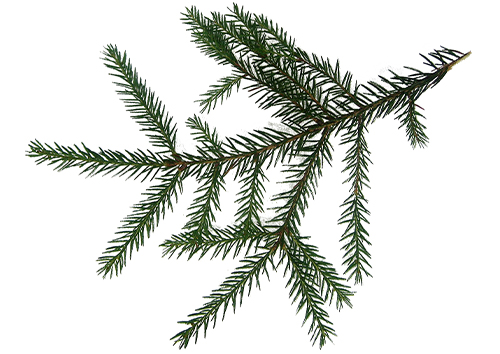
- Spruce (E)
- Gran (S)
- Fichte (D)
- le sapin (F)
Spruce is the last tree species that spread to Finland after last ice age.
Distribution#
- Spruce grows in the North European boreal forest zone, also known as taiga.
- Spruce thrives almost everywhere in Finland. The only exceptions are the fells above the coniferous treeline.
- It is the second most common tree species in Finnish forests, for approximately 36% of the trees are spruce.
Habitat#
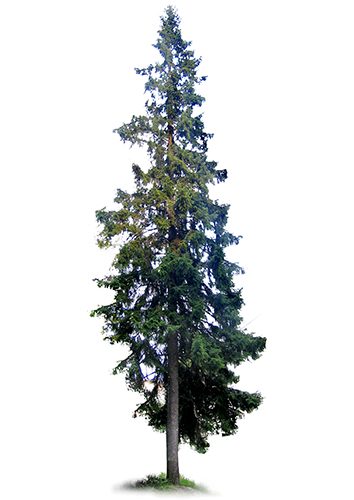
- Spruce prefers a shady habitat. Young spruces are sensitive to frost.
- A good habitat is a grassy woodland or a dry peaty blueberry forest with heavy moss and lichen cover, which has fresh soil rich in nutrients.
- It is vulnerable to dry conditions, storms, air pollutions and damage caused by rot.
- In a poor habitat spruce provides good quality wood if it grows densely enough. In such conditions the trunk grows fewer branches.
Growth characteristics#
- Spruce is an evergreen tree, whose crown is broadish and conical.
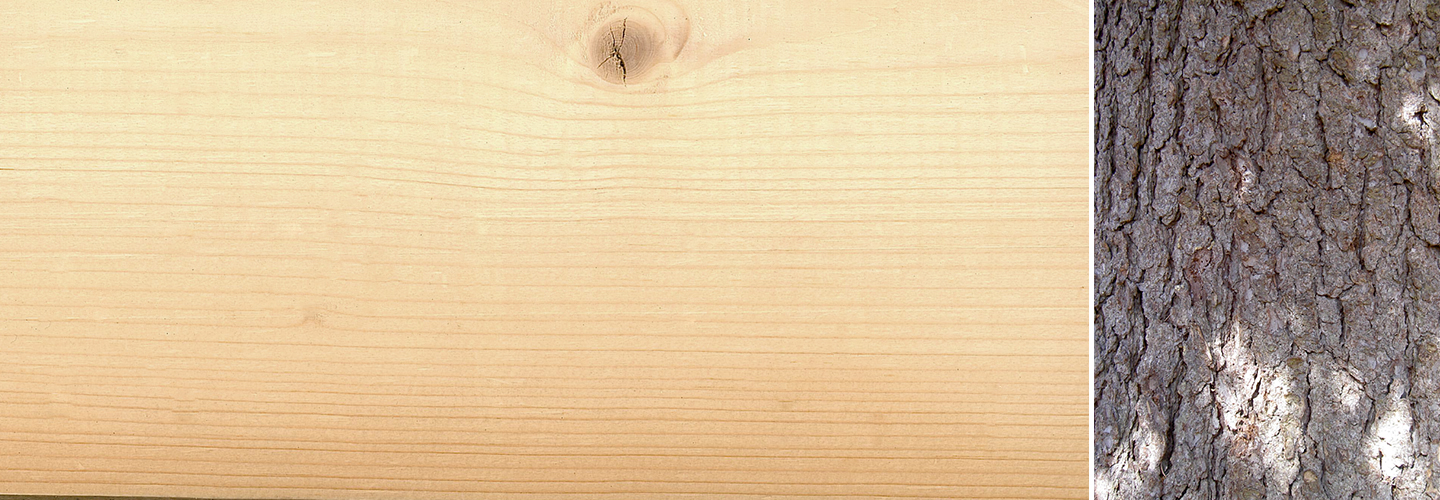
- Spruce may grow up to 40 meters high and one meter thick. Its trunk is grey or brown and the bark is rough.
- The trunk of a quality spruce is straight and limbless. The lower stem is free of knots or the knots are small. The trunk has to be smooth and clean from resin leaks.
- A quality log taken from the lower stem has a diameter of at least 30 cm.
- The root system is quite shallow, and therefore spruce stands are vulnerable to storm damage.
- The Finnish spruce has several subspecies. One of them is the siberian spruce (Picea abies subsp. obovata), which has a thinner crown than a common spruce, and which grows in Northern Finland.
Characteristics of wood#
- Spruce wood is light-coloured, and the yellowish heartwood is not clearly distinguished from the cambium.
- Spruce is straight grained and flexible to a lesser extent.
- The wood shrinks a little during the drying process, but it warps more than pine wood. Wood with thinner annual rings is harder and shrinks less.
- It cracks easily, but withstands humidity variation well.
- From the point of view of the carpentry industry, the disadvantages of spruce are its numerous branches and resin.
- A-class spruce wood is, at its best, raw material for musical instruments. Then it has grown in a dry peaty forest with heavy moss and lichen cover, because in such conditions its annual rings grow thin and even.
- The weight of air-dry sawn timber is 300- 480 kg/m3.
- A-class wood is even in colour. Its surface should be smooth. The thickness of the annual rings should not be over 3 mm.
- B-class spruce has more branches and it is more fast-growing. It is used for making glue boards, furniture and boards.
- C-class spruce is not generally used in the carpentry industry. It is used for building logs and other building materials.
Surface treatment#
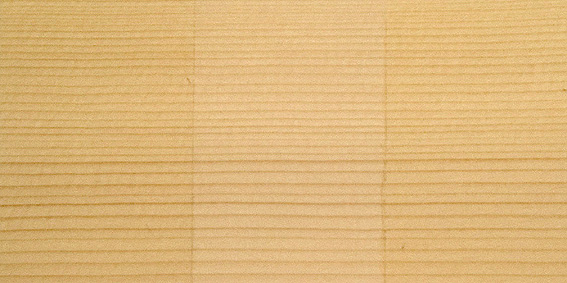
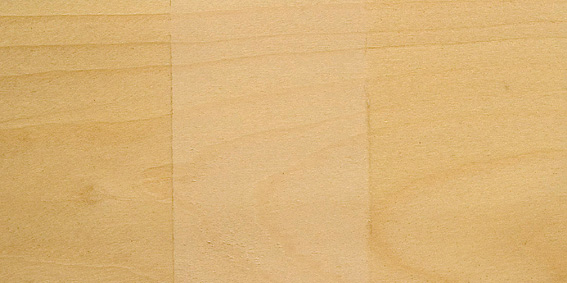
The wood samples have been surface treated as such:
- Left, water-based acrylic lacquer
- Center, no treatment
- Right, two component catalystlacquer or oil
Usage#
- Spruce is used for making; furniture, doors, window frames and other building materials.
- It is also used in the packaging industry and as raw material for plywood.
- Quality spruce is used for making musical instruments, for example violins.
- Spruce is good long-fibered raw material for the paper industry and different chemical products, such as synthetic fibers (viscose)
- Uses from the past: charcoal, roof shakes, tanning, musical instruments, fencing, floors, weatherboarding